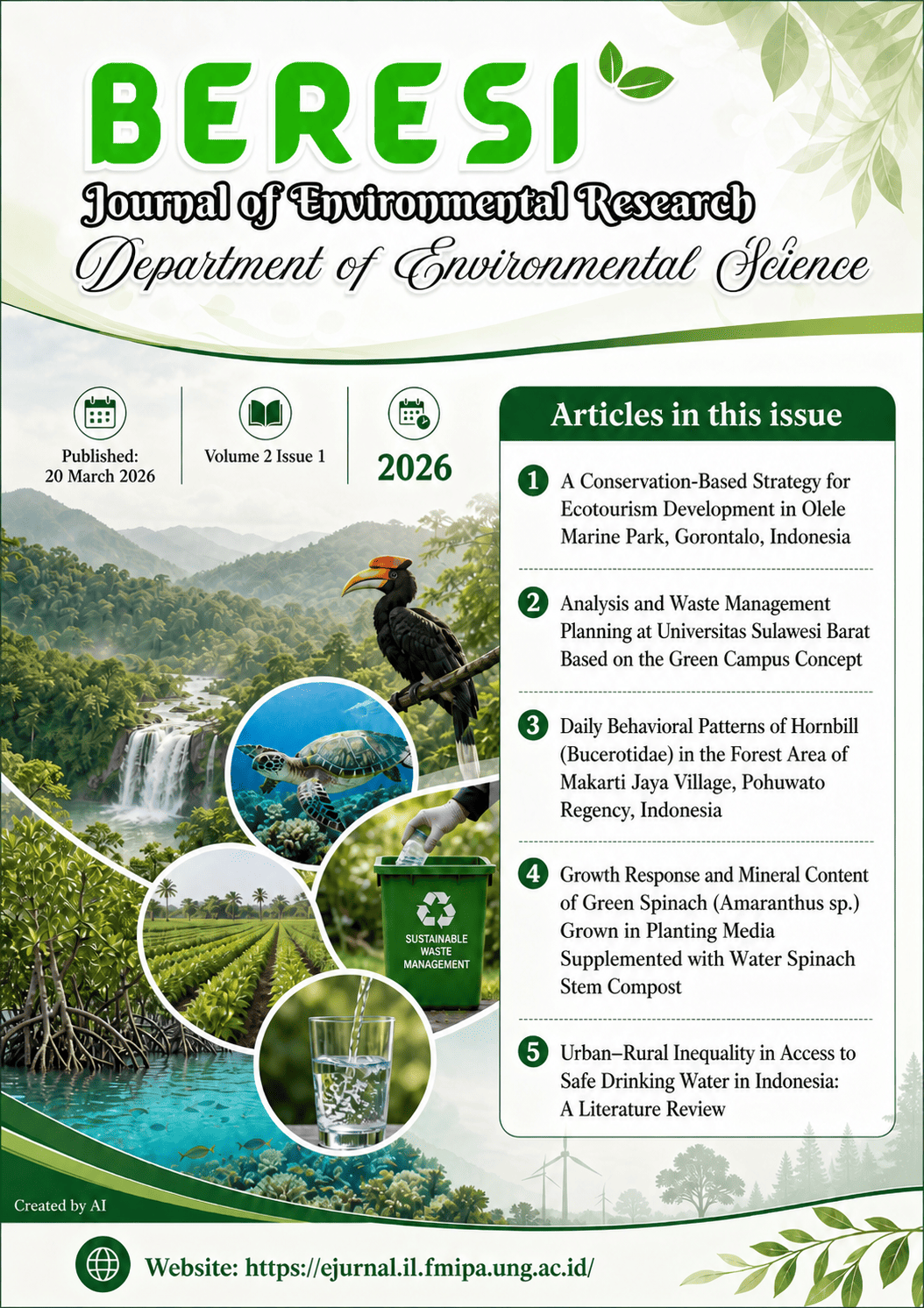
Growth Response and Mineral Content of Green Spinach (Amaranthus sp.) Grown in Planting Media Supplemented with Water Spinach Stem Compost
DOI:
https://doi.org/10.37905/bje.v2i1.12Keywords:
Green spinach, Mineral content, Organic compost, Plant growth, X-Ray fluorescenceAbstract
Background: Green spinach (Amaranthus sp.) is a leafy vegetable with high nutritional value and is widely consumed by the community. The use of organic compost as a planting medium supplement is one strategy to improve plant growth while utilizing organic waste. Water spinach stems (Ipomoea aquatica) have the potential to be processed into compost; however, their effectiveness as a planting medium supplement for green spinach growth and mineral accumulation has not been widely studied. Objective: This study aimed to analyze the effect of planting media supplemented with water spinach stem compost on the growth and metal/mineral content of green spinach. Methods: This research employed an experimental method using a Completely Randomized Design (CRD) consisting of five treatments and five replications. The treatments included K0 = 100% soil, K1 = 70% soil + 30% water spinach stem compost, K2 = 50% soil + 50% compost, K3 = 25% soil + 75% compost, and K4 = 100% compost. The observed growth parameters included plant height, number of leaves, fresh weight, dry weight, and root length during 35 days after planting. Growth data were analyzed using analysis of variance (ANOVA) at a 5% significance level, while the metal/mineral content of green spinach was analyzed descriptively using X-Ray Fluorescence (XRF). Findings: The results showed that water spinach stem compost supplementation did not significantly affect plant height, number of leaves, and root length. However, significant differences were observed in fresh weight and dry weight. The highest fresh weight was found in the control treatment (K0) at 111.8 g, followed closely by K1 at 111.4 g, while the lowest value was recorded in K4. Similarly, the highest dry weight was obtained in K0 at 16.2 g, whereas the lowest dry weight was found in K4 at 5.4 g. XRF analysis showed that green spinach contained several dominant mineral compounds, including K₂O, Na₂O, CaO, MgO, and Fe₂O₃, with varying percentages among treatments. Trace amounts of heavy metal compounds such as CdO and Sb₂O₃ were also detected. Conclusion: Planting media supplemented with water spinach stem compost did not consistently improve the growth of green spinach. The use of excessive compost, particularly 100% compost, tended to reduce plant biomass. The best growth performance was generally observed in the control treatment and in the moderate compost treatment. Novelty/Originality: This study provides preliminary information on the use of water spinach stem compost as an organic planting medium supplement and its relationship with growth performance and mineral composition in green spinach.
Downloads
Published
How to Cite
Issue
Section
License
Copyright (c) 2026 This work is licensed under a Creative Commons Attribution-ShareAlike 4.0 International License.

This work is licensed under a Creative Commons Attribution-ShareAlike 4.0 International License.